Replacing email and DocuSign with a booking system for film and TV location scouting
- Industry
- PropTech / B2B
- Timeframe
- 2024
- Role
- UX and Product Design
- Skills
- Product strategyInformation architectureUser Flow MappingPrototyping
A platform connecting creative agents (film, TV, advertising, brand teams) with curated shoot locations, and the property owners who host them. The product fills a gap left by general listing sites that explicitly disallow commercial filming, and replaces an email-and-spreadsheet workflow that had outgrown what the team could sustain by hand.
Context
Before the product, the entire workflow ran on email. Agents would send a brief, the platform team would manually curate a shortlist, reply with pricing, negotiate availability, draft DocuSign contracts, and chase calendar invites. All of it across hundreds of properties and dozens of clients, all of it stitched together by hand.
The team had grown beyond what inboxes and spreadsheets could carry. There was an immediate, operational need to move the workflow into a real product, without losing the relationship-led, curated feel that made the service work in the first place.
Impact at a glance
9h
Hours of admin work saved per week
<24h
Average turnaround from brief to curated shortlist
70%
Fewer back-and-forth touchpoints per booking
Audience
The product serves three user groups. Understanding what each one came to do, and how often they would return, shaped where the experience had to split and where it could stay shared.
-
Creative clients
Agents from film, TV, advertising, and brand teams. They submit briefs or pick specific properties, then track their pipeline of upcoming shoots.
-
Platform admins
Curate the property library, process incoming requests, assign scouts, and oversee bookings end to end. The operational core of the product.
-
Property owners
Submit spaces they own, connect with the scouts booking them, set the terms of how their spaces can be used on set.
Out of scope for MVP
Key pain points to solve
- Creative clients
- Platform admins
Briefs land in every shape
Some arrive pixel-perfect with references and a mood. Others say "somewhere moody for a half-day in Dublin." The product has to absorb both without forcing structure that isn't there.
Small jobs hide real value
Scale doesn't predict revenue or admin effort. A short, fast booking can still be lucrative, so the product cannot equate "small request" with "low priority."
Scouting eats the agent's day
Clients want fewer back-and-forths and don't want to source locations themselves. The platform has to do the scouting work that used to live in their calendar.
The same admin questions, on repeat
Repetitive coordination (availability checks, the contract dance, calendar pings) drains the operations team. Most of it is templated work disguised as judgement.
No central view of who's waiting on what
Across hundreds of properties and dozens of active clients, status lived in inboxes and spreadsheets. Nobody could see, at a glance, where each job was stuck.
Different anxieties, same data
Clients want a calm tracker, low frequency, high stakes. Admins want a throughput console, high frequency, many parallel jobs. One backend has to serve both without conflating them.
Approach
Started with a series of discovery sessions aimed to ground the project in both business and user reality. The work spanned stakeholder interviews, persona mapping exercises across each side of the platform, and a walkthrough of the current submit-and-book process from first enquiry to confirmed shoot.
A handful of specifics shaped everything that followed. Curation, not listing volume, was the brand's edge, and it had to stay intact as the workflow moved out of email. Clients were often handling discreet, high-profile shoots where privacy and security mattered as much as visual fit, and where conventional platforms (booking.com, Airbnb) actively disqualified themselves by disallowing commercial filming. The operational stack (Squarespace, Google Forms, SimplyBook, Google Calendar, manually built spec sheets) was holding the business together with friction the team had stopped noticing. The heaviest single drain was the back-and-forth: repeated availability checks, status chases, and the contract dance that had become a near full-time job.
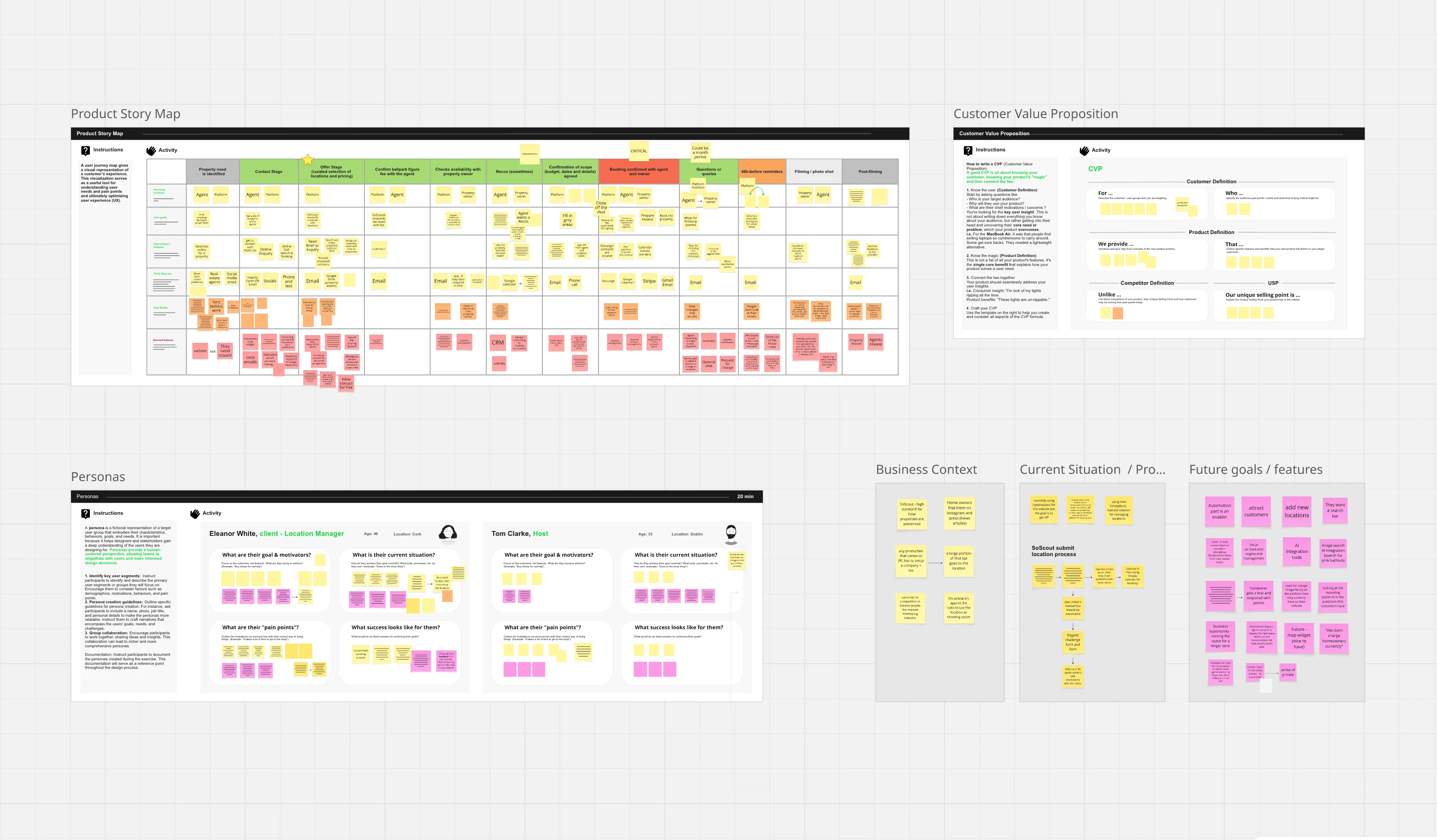
The personas made it obvious that one interface could not carry both audiences. The same booking record meant something very different to a client preparing for a once-in-a-quarter shoot than it did to an admin moving twenty parallel jobs through the week. From there the product split into two coordinated experiences, each shaped by what its audience came to the platform to do, and each able to hold both ways clients arrive: directed, when they already know the property they want, and briefed, when they are bringing a vision and need help finding the match.
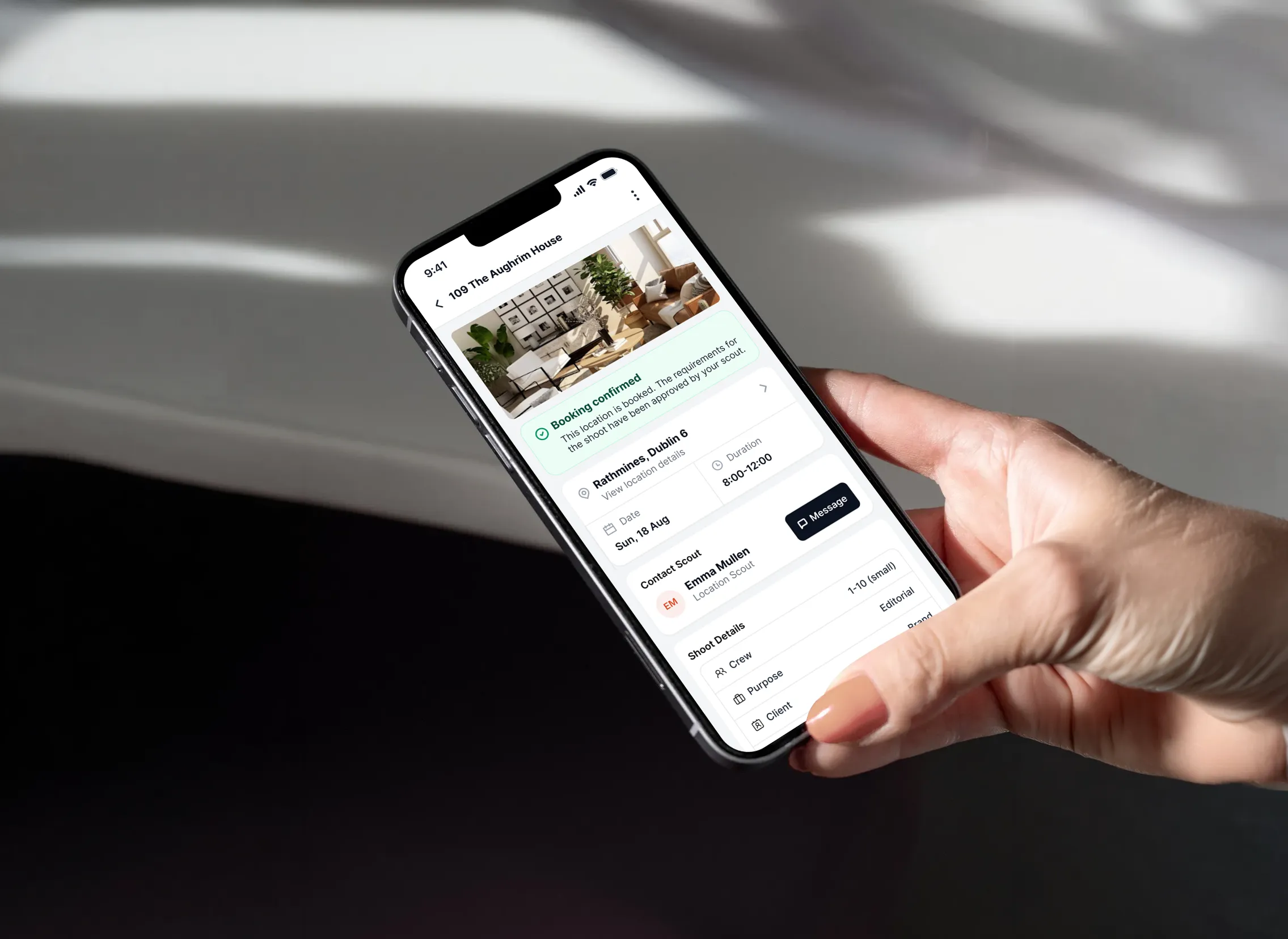
Client side
A tracker built around reassurance
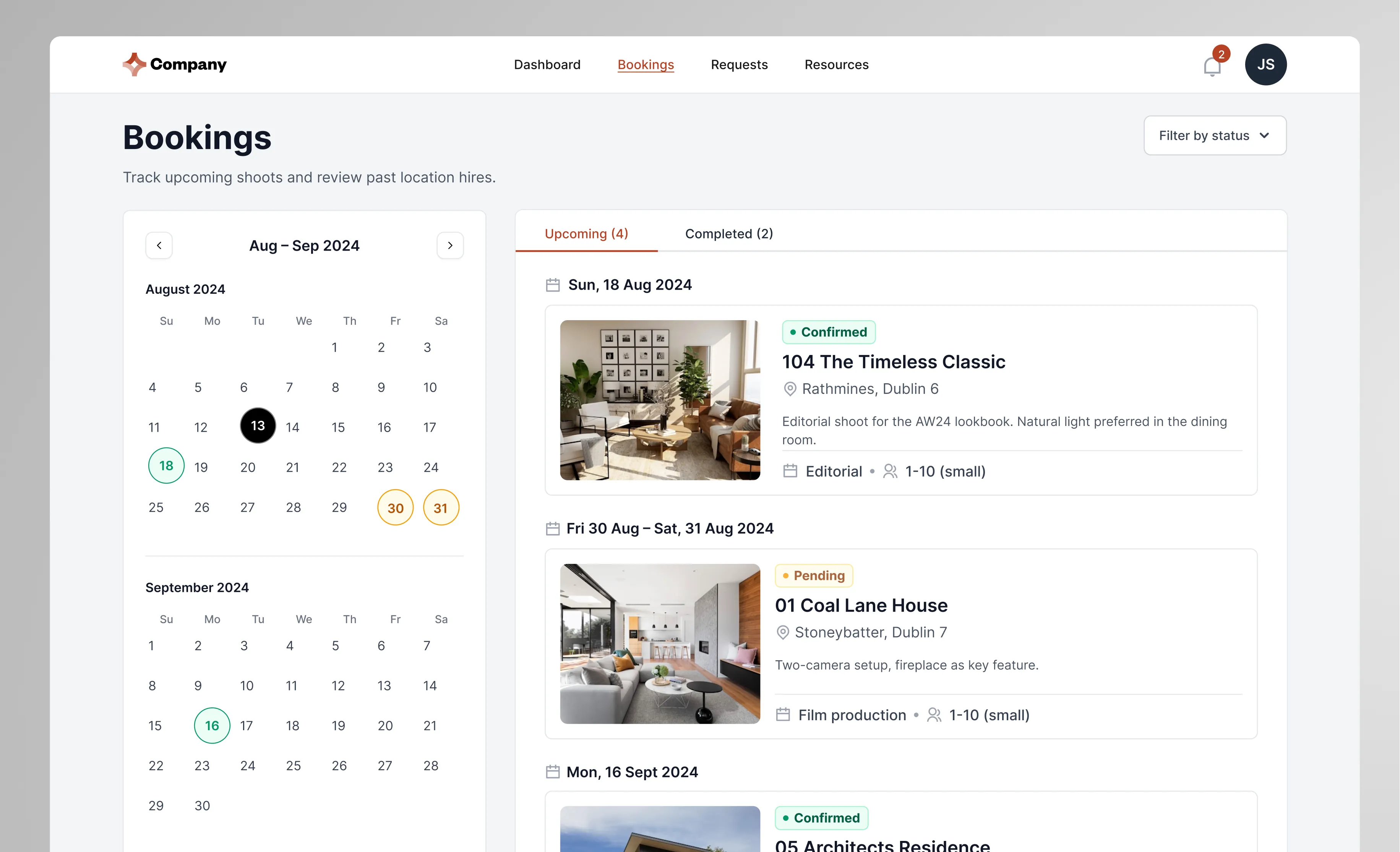
Reassurance is the primary job of the client side: a clear pipeline of upcoming shoots, status visible without asking, and a single entry point that branches into either submitting a brief or selecting a specific property.
.BPq66PNP_Qluku.webp)
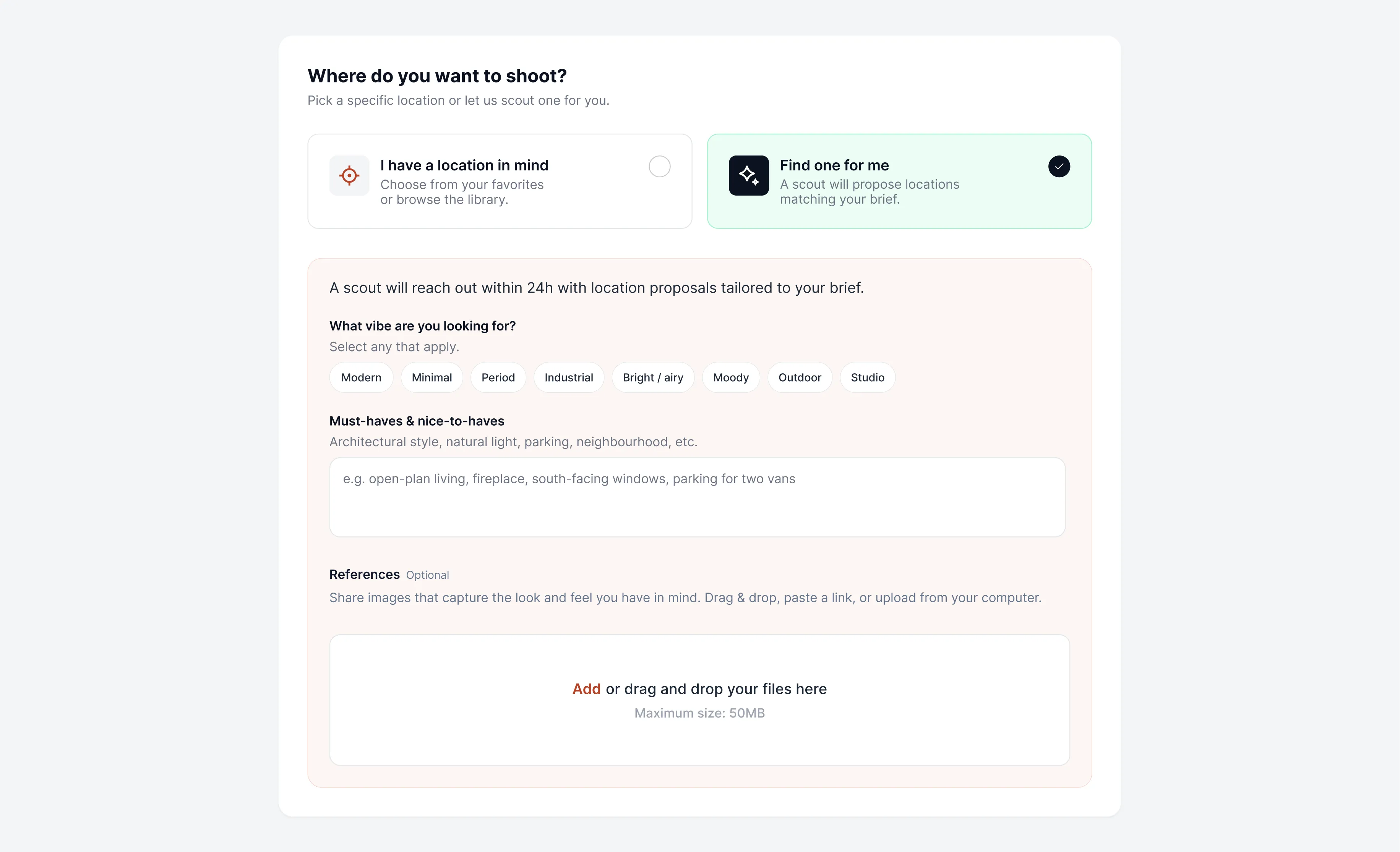
Mapping the client booking flow
The intake runs as a stepped wizard, branches once on how the client wants to start (directed or briefed), then converges through owner approval, contract, and payment to a confirmed shoot.
Bookings live in a calendar view with colour-coded status, sitting next to a tabbed list of upcoming and completed shoots. The brief intake gives clients a structured vocabulary for the things scouts ask about most (vibe tags, must-haves, reference uploads), so what arrives is rich enough to act on without a follow-up email. Each confirmed booking opens into a detail panel that surfaces the assigned scout's contact, so any clarification has a clear person on the other end.
Admin side
A console for everything in motion
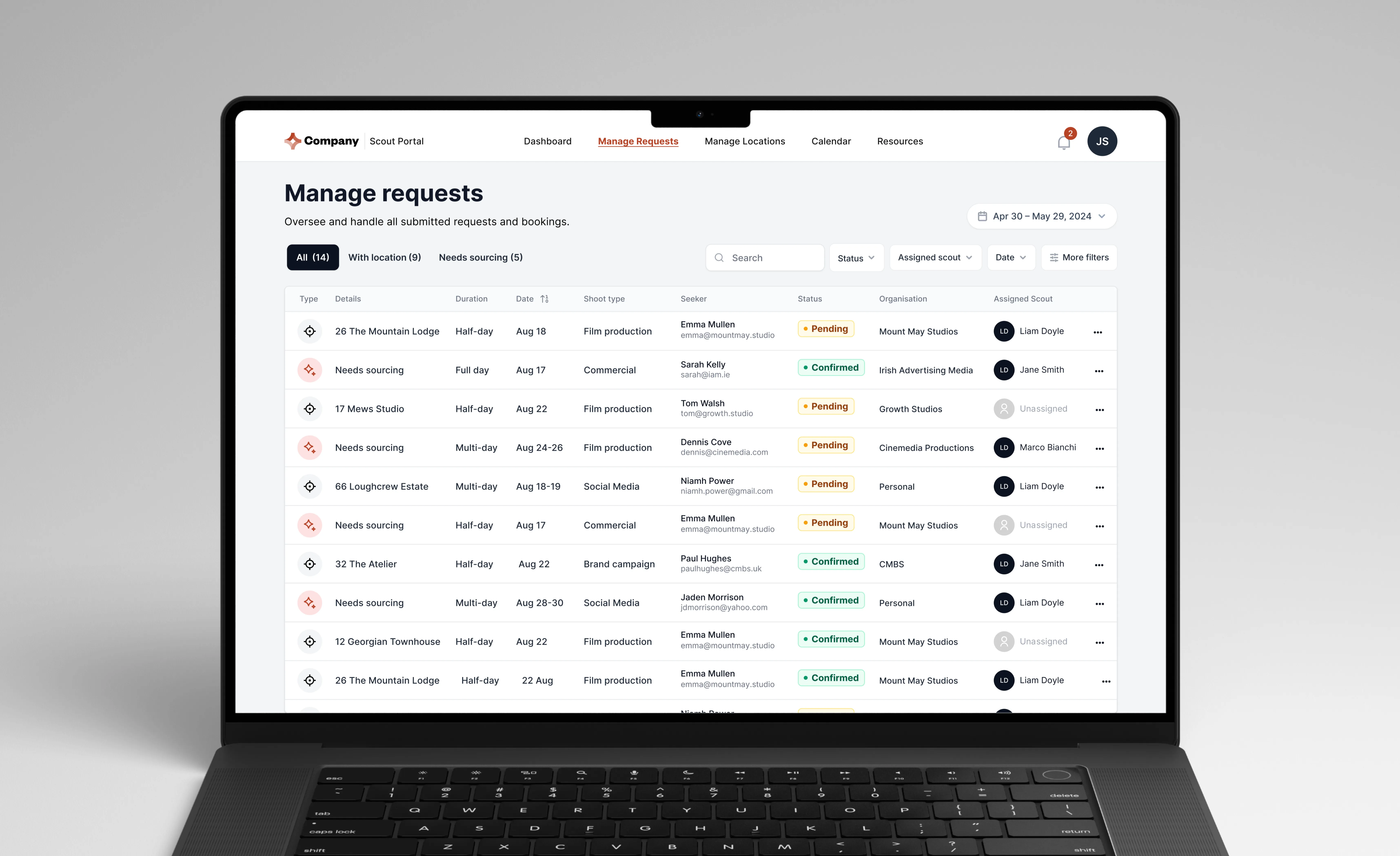
The admin side is the operational core of the product: every active request, every assigned scout, every property in the library is reachable from one place, with status as the dominant signal.
.CzZ1CZYZ_DAYoP.webp)
The Manage Requests board groups every active job in one place, with quick filters for With location and Needs sourcing so scouts can pick up exactly the work that fits their slot. Inside a sourcing request the brief sits side by side with the proposed locations, and each proposal carries a short note the scout writes back to the client explaining why it works for the brief, turning the back-channel conversation that used to live in email into part of the booking record.
Reflections
The platform replaces an email and spreadsheet workflow without losing what made the service work in the first place: curation, judgement, and the relationships that come with both.
Outcomes
Status as the dominant signal across requests, scouts, and properties means the team no longer relies on inboxes as tracking systems. The client and admin sides move in step, with a more seamless, transparent flow of information between them.
Expected shifts
Clients see where each shoot stands without chasing updates. Admins see where each request is held up without digging through inboxes. Both sides work from the same live record, instead of trading status questions across email.
What comes next
The roadmap leans into supporting the owner side, image-based search for visual specifics (a Georgian fireplace, a pink bathtub), and shortlists trained on repeating brief patterns. Together they speed up the match without losing the curated feel.